
Spotify AI Persona Badge Arrives in September: What It Means for Music
Last summer a band called Velvet Sundown appeared on Spotify, gathered hundreds of thousands of listeners, and turned out not to exist. No members, no instruments, no recording session. An entirely fabricated act, generated and uploaded, sitting in playlists alongside people who had spent decades learning to play.
Spotify has now responded. From mid-September 2026, fully AI-generated artist identities will carry a Spotify AI Persona badge and will be excluded from editorial and algorithmic recommendations by default. The scale of the problem behind that decision is larger than most listeners realise.
The Number That Explains Everything
In April 2026, the French streaming service Deezer estimated that 44 percent of all new songs uploaded to its database were created by AI. That works out to roughly 75,000 AI-generated tracks arriving every single day on one platform.
Not 44 percent of everything on the service. Forty-four percent of everything new. If that trajectory continues, the majority of music uploaded to streaming platforms will soon be machine-generated, and the humans competing for attention will be a minority in their own industry.
That is the context for what Spotify announced on 11 August.
What the Spotify AI Persona Badge Actually Does
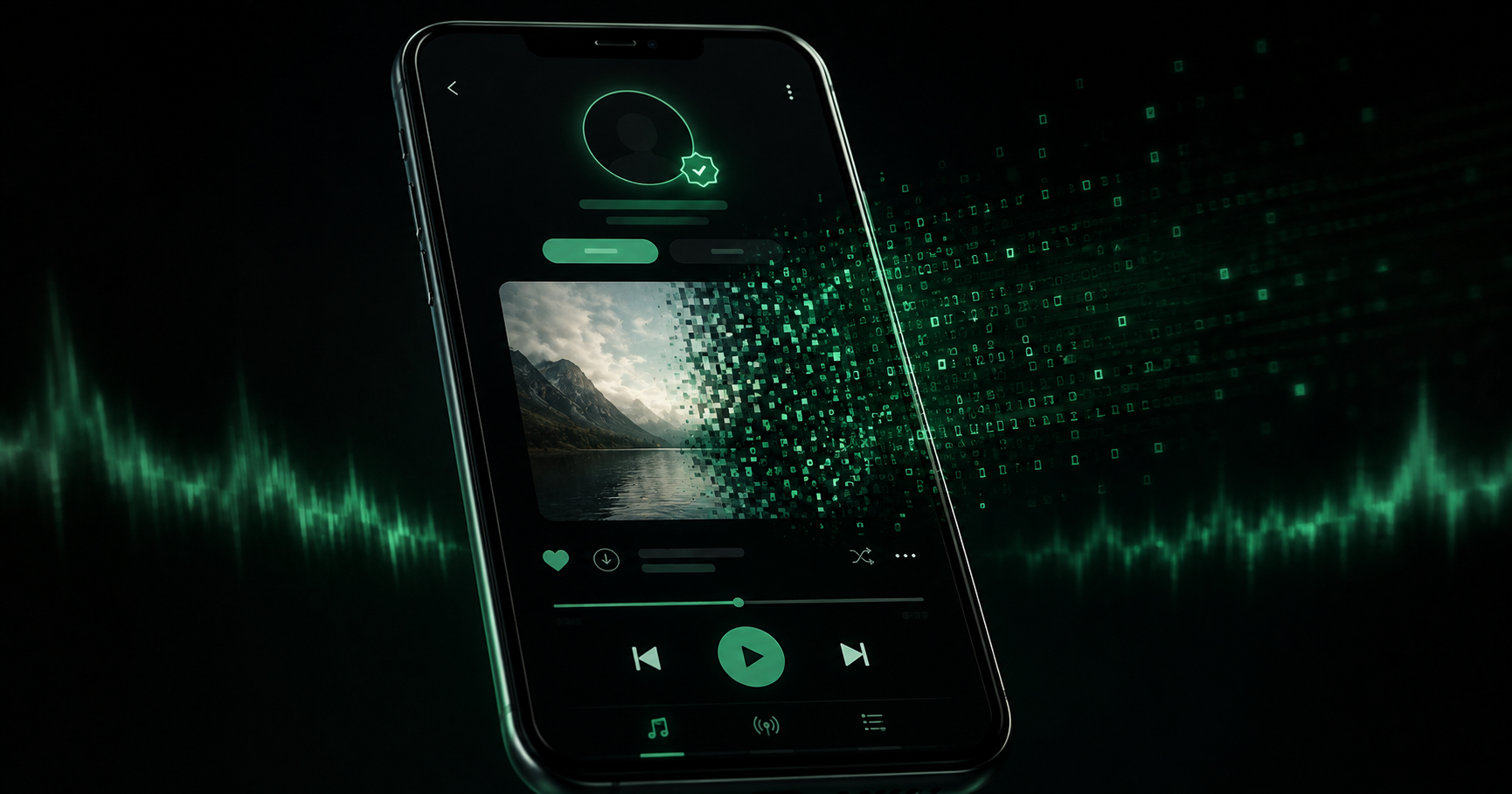
From mid-September, a badge will appear on affected artist profiles, in search results, and alongside tracks in playlist listings. Those profiles will be excluded by default from editorial recommendations, algorithmic recommendations, and personalised playlists.
Crucially, this is not a ban. Listeners can still search for these artists, play their music, and follow them deliberately. If you follow an AI Persona, their music continues to appear in your recommendations.
That distinction is the entire point. Spotify is not ruling on whether AI-made music should exist. It is ruling on whether an AI-generated identity deserves the same automatic access to listener attention as a person who has spent years building a craft.
Spotify’s own framing was unusually direct: true artist and fan connection can only be built on a foundation of trust and authenticity, and listeners need to be able to trust that the artist behind the music is who they say they are. To read more coverage of the music industry and global entertainment, visit GmoArena’s Celebrity section.
The Distinction That Protects Real Musicians
This is the part that has been widely misreported, and it matters enormously to working artists.
The badge applies to the artist’s identity, not to how the music was made. A human musician who uses AI tools during production is not automatically classified as an AI Persona. Spotify stated plainly that the badge is about the artist’s public identity rather than about how the music was created.
That matters because AI production tools are now everywhere in music. Empire of the Sun, Two Shell, Diplo, Tyga, and ABBA’s Björn Ulvaeus have all acknowledged using AI in their work recently. Under a policy targeting production methods, all of them would be caught. Under this policy, none of them are.
The target is specifically the fabricated identity: a profile presenting a photorealistic person who does not exist.
How Spotify Will Identify Them
Artists have been able to self-declare as AI Personas through Spotify for Artists since 11 August 2026. Labels become publicly visible from mid-September.
Spotify has explicitly said it will not rely on self-disclosure alone. The company will independently review artist profiles using a combination of human review and automated analysis, looking for names and imagery suggesting a photorealistic but fictional identity.
The rollout starts with artists meeting defined audience thresholds, prioritising the profiles listeners actually visit rather than attempting to review millions of dormant accounts at once.
Artists flagged by Spotify will be notified and can appeal. A reporting tool letting listeners flag unlabelled profiles they believe are AI Personas is planned for the coming months.
Where the Policy Has Gaps
Two significant blind spots are worth naming.
AI tracks from real artists are untouched. The policy does not address AI-generated songs released under a genuine human artist’s name. The recent viral track Rubberz from Fenix Flexin generated exactly this controversy and would not be caught by an identity-focused badge.
The definition of AI remains vague. Artificial intelligence now covers everything from full song generation to pitch correction and mastering assistance. Where a policy draws that line determines who it affects, and the current framing leaves considerable room for interpretation.
There is also a certain irony in the timing. Artists including Lorde recently pushed back against Spotify’s own AI feature, About The Song, which generates sometimes-inaccurate facts about tracks as they play. The platform policing AI authenticity is simultaneously deploying AI in ways artists have objected to.
What This Means for Musicians
For working musicians, particularly independent artists without label backing, this is meaningful protection. Algorithmic recommendation is how most new listeners discover new music, and competing against an unlimited supply of machine-generated tracks for those placements is a losing proposition. Removing AI Personas from that pool restores some proportion.
Whether it is enough is a separate question. Deezer’s 44 percent figure describes a flood, and a badge on the loudest profiles addresses visibility rather than volume.
For listeners, the practical effect is straightforward. From mid-September you will be able to tell, before pressing play, whether the artist on your screen is a person. That information was not previously available and its absence is precisely what made Velvet Sundown possible.
The Remix Deal Running Alongside It
The Spotify AI Persona policy arrives alongside licensing agreements with Universal Music Group and Merlin that will permit AI-generated remixes and covers on the platform, with revenue routed back to participating artists.
Spotify is drawing a line rather than rejecting AI outright. Fan-made AI remixes of licensed music, with the original artist compensated, are acceptable. Fabricated artists absorbing listener attention that would otherwise reach human musicians are not.
Given that AI music generation is not going to slow down, a distinction between consensual compensated AI and identity fabrication is probably the most realistic position a platform can take.
What is a Spotify AI Persona?
A Spotify AI Persona is an artist profile representing a fully AI-generated identity rather than a real person. From mid-September 2026, these profiles carry a badge visible on the artist page, in search results, and in playlist track listings, and are excluded by default from editorial, algorithmic, and personalised recommendations. Listeners can still search for, play, and follow these artists deliberately. The badge applies to the artist’s public identity rather than to how the music was produced, meaning human musicians who use AI tools during production are not classified as AI Personas.
How much music on streaming platforms is AI-generated?
In April 2026, the French streaming service Deezer estimated that 44 percent of all new songs uploaded to its database were created by AI, amounting to roughly 75,000 AI-generated tracks per day on that platform alone. The figure describes new uploads rather than the total catalogue, but it indicates that machine-generated music is arriving at a volume that makes it a majority of new content on some services, which is the concern driving Spotify’s labelling policy.
Will Spotify ban AI-generated music?
No. Spotify’s policy labels AI-generated artist identities and removes them from default recommendations, but does not remove the music from the platform. Listeners who search for these artists can still play and follow them, and following an AI Persona means their music will continue appearing in recommendations. Spotify has separately signed licensing deals with Universal Music Group and Merlin to permit AI-generated remixes and covers with revenue routed to participating artists, indicating the company is regulating AI music rather than rejecting it.
The Short Version
Forty-four percent of new uploads on one major platform are already machine-made. Spotify’s response is a badge, a recommendation exclusion, and a distinction between fabricated identities and human artists using AI tools.
It is a reasonable policy that arrives late, addresses visibility rather than volume, and leaves a significant gap around AI tracks released under real artists’ names. It is also the most substantial position any major streaming platform has taken on the question, and it will be visible on your screen from mid-September.
For more coverage of music, entertainment, and the global culture industry, visit GmoArena’s Celebrity section.
Sources and Further Reading
- TechCrunch on the Spotify AI Persona announcement and licensing deals with UMG and Merlin
- Stereogum on Deezer’s AI upload figures and the policy’s gaps around human artists using AI
- Android Headlines on self-disclosure timelines, appeals and Spotify’s detection approach
About this article: Written by the GmoArena editorial team covering global celebrity culture, mobile technology, travel destinations, and the stories that matter.
Editorial Note: Details in this article are based on Spotify’s announcement of 11 August 2026 and reporting from TechCrunch, Stereogum, Android Headlines, and The AI Insider. Implementation details including audience thresholds and appeal processes had not been fully published at the time of writing. Deezer’s AI upload estimate is that company’s own figure and describes its platform specifically.