
Japan’s Kumamoto Earthquake 2026: What Happened, Who Was Affected,and What Travellers Need to Know
Japan’s Kumamoto Earthquake 2026: What Happened, Who Was Affected, and What Travellers Need to Know
kumamoto earthquake 2026
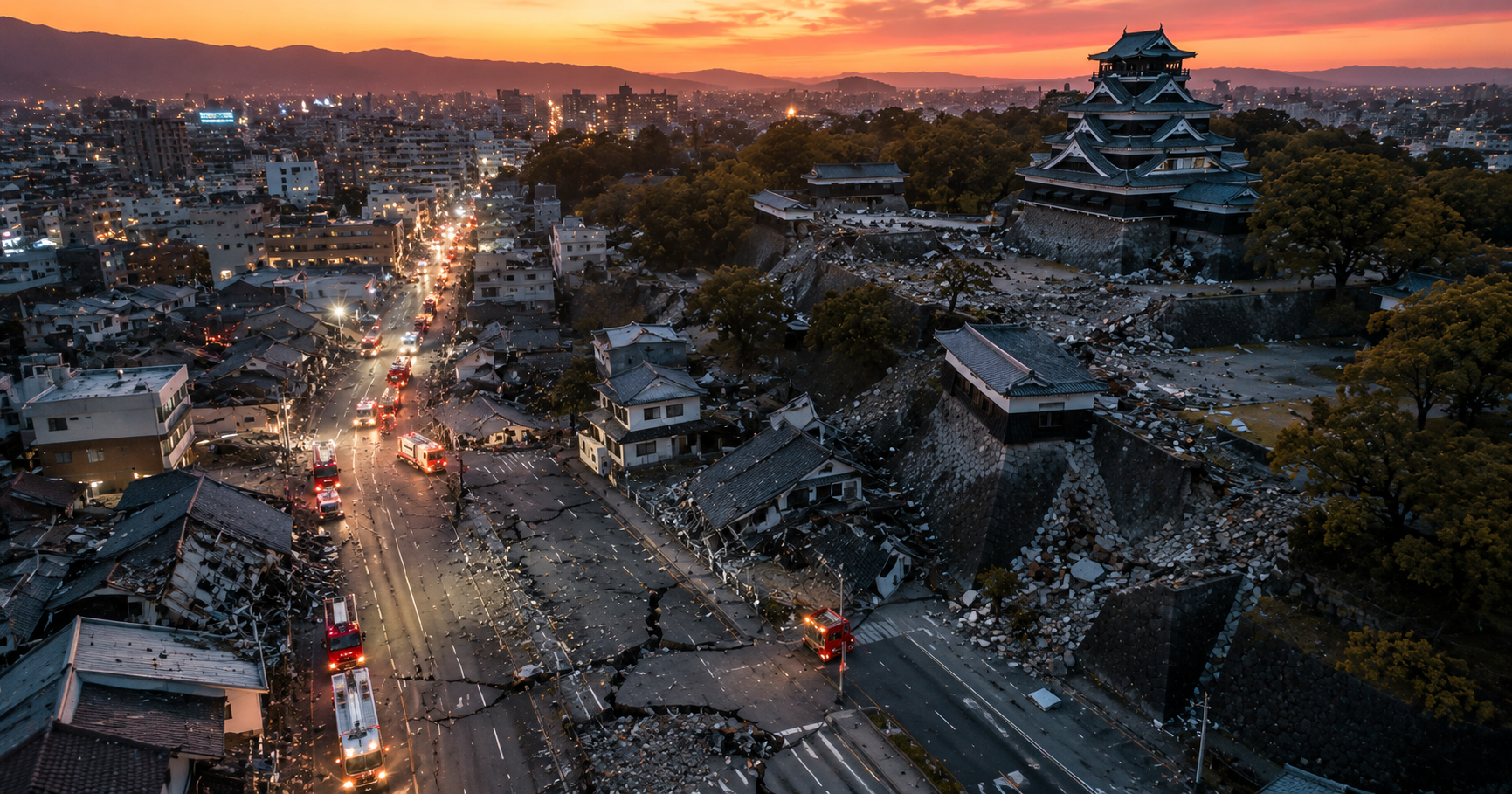
At 4:27 in the afternoon on July 28, 2026, the ground beneath Kumamoto shook with a fury that the prefecture had not felt in a decade. A magnitude 7.1 earthquake struck Kumamoto Prefecture on Japan’s southwestern island of Kyushu, registering the maximum shindo 7 intensity on Japan’s seismic scale in Uki City and Hikawa Town, according to the Japan Meteorological Agency. Within minutes, buildings had collapsed, fires had broken out in Kumamoto City, shoppers were trapped inside a partially collapsed shopping mall, and the machinery of Japan’s extraordinary disaster response had been set in motion.
Three days on, at least 18 people have been confirmed dead and at least 62 others have been injured, six of them seriously, according to NPR’s reporting citing Kumamoto prefectural government figures. Rescue crews remain in a race against time, and authorities have warned that strong aftershocks will continue in the days ahead. For a region that already endured devastating earthquakes a decade ago, the 2026 Kumamoto Earthquake has reopened wounds that never fully healed.
What Happened A Minute-by-Minute Account
The earthquake struck without warning at 16:27 local time on July 28. The epicentre was located just east of Uto and south of Kumamoto City, close to the surface at a relatively shallow depth, which amplified the intensity of shaking felt at ground level, according to the Japan Meteorological Agency.
A tsunami advisory was issued immediately after the quake, sending coastal communities into evacuation. The advisory was later lifted when monitoring confirmed no significant tsunami wave had formed, according to Al Jazeera. But the shaking itself had already done enormous damage across Kumamoto and neighbouring Yatsushiro.
At the Aeon Mall in Kashima, one of the region’s busiest shopping centres, an explosion occurred following the earthquake as structural systems failed. Five people were killed at the Aeon Mall in Kashima, where the explosion took place after the quake struck, according to Nippon.com’s official tally. Shoppers who survived described chaos as products flew from shelves and sections of the building came down around them.
At the Nippon Paper Industries mill in Yatsushiro, a factory chimney snapped off and collapsed onto workers below. Eight people were killed at the Nippon Paper Industries factory in Yatsushiro, where a collapsed chimney trapped eleven workers, according to Nippon.com. Soldiers and emergency workers combed through the factory debris looking for survivors, with nine people still reported missing at the Yatsushiro site as of July 29, CNN reported.
The Response Japan’s Disaster Machine Activates
Japan’s disaster response infrastructure, refined through generations of seismic experience, activated within minutes. The government established the Extraordinary Disaster Management Headquarters for the 2026 Kumamoto Earthquake, chaired by Prime Minister Sanae Takaichi, at 18:20 on July 28 less than two hours after the initial quake, according to Japansoso’s time-stamped account of official government actions.
The Self-Defense Forces were initially deployed at approximately 3,600 personnel, a figure that Defence Minister raised to roughly 4,600 at a press conference on July 29, according to Japansoso. Soldiers worked alongside emergency services in sweltering summer heat an additional challenge that authorities acknowledged raised risks for both rescuers and survivors awaiting help.
One eyewitness, Kiyoshi Matsunaga, 74, who was at a supermarket near the Aeon Mall when the earthquake hit, described the moment: things scattered from the shelves and he could not move as he stood at the cash register, according to NPR’s on-the-ground reporting. For the foreigner who was among those killed the first reported international fatality in the disaster their identity and circumstances had not been confirmed publicly as of the latest reporting.
Kumamoto What the World Needs to Know About This City
Kumamoto is not just a name on a disaster map. It is one of Japan’s most historically significant and scenically remarkable cities, and understanding what makes it special gives the earthquake’s impact its full weight.
At the center of Kumamoto’s identity stands Kumamoto Castle, one of Japan’s finest surviving feudal castles, built in the early 17th century and recently restored after the devastating 2016 earthquakes that shook the same region. The castle is a symbol of the city’s resilience and a major draw for both Japanese and international visitors. It sits on a hill above the city, and photographs of its black and white walls against Kumamoto’s green landscape are among the most recognizable images in Japanese tourism.
Kumamoto Prefecture also encompasses Mount Aso, the world’s largest volcanic caldera, which draws visitors from across the globe who come to see its active crater, grassy caldera plains, and dramatic highland scenery. The city is known throughout Japan for basashi, raw horse sashimi that has been a regional specialty for centuries and is sought out by culinary tourists. Its ramen, its hot springs, and its castle town character make it one of Kyushu’s most visited destinations. To explore more of Japan and the world’s most remarkable destinations on GmoArena, browse our full Famous Places coverage.
Kumamoto Has Been Here Before
The 2026 earthquake arrived in a city that still carries the memory of its last great trauma. In April 2016, two powerful earthquakes struck Kumamoto within 28 hours of each other, killing 50 people, injuring more than 3,000, and causing widespread damage to the castle, historic buildings, and homes across the region.
The reconstruction that followed became a symbol of Japanese determination. Kumamoto Castle underwent a years-long restoration project that painstakingly rebuilt the damaged sections. The city rebuilt its roads and housing. Tourism returned and eventually exceeded pre-disaster levels as visitors came to see the reconstructed castle and support the region.
The 2026 earthquake strikes a city that has only recently finished putting the 2016 disaster behind it. The emotional impact on Kumamoto’s residents, who faced a decade of rebuilding only to face catastrophic shaking again, has been noted throughout Japanese media coverage of the disaster.
Honda, Industry, and the Economic Ripple
The earthquake’s impact extends beyond its immediate human toll into Kumamoto’s industrial heart. Honda Motor announced it would extend the shutdown of its motorcycle plant in Kumamoto until Friday to allow repairs to parts of the factory damaged by the earthquake, according to Al Jazeera. Kumamoto has become increasingly important to Japan’s semiconductor and technology supply chain in recent years, with TSMC Japan having established a major chip fabrication facility in the prefecture. The status of those facilities and their potential impact on global technology supply chains was under assessment following the quake.
Power outages affected thousands of homes across the region immediately after the earthquake, and as of the latest reports, roads remained severed in several areas, complicating rescue operations and supply delivery to affected communities.
Is Japan Safe to Travel Right Now?
For travellers who have Japan on their itinerary, this is the question that immediately follows any major earthquake news. The honest answer, as with any seismically active country, requires nuance. Japan’s building standards are among the strictest on Earth, specifically designed around earthquake resistance. The majority of the country’s tourist infrastructure hotels, railways, airports was built or upgraded to meet those standards and performs well even in significant seismic events.
For Kumamoto Prefecture specifically, travellers should follow official guidance from Japan’s government and their own government’s travel advisories. Mount Aso and the castle district will likely require assessment of access and conditions before tourist visits resume normally. Other parts of Kyushu, and the rest of Japan, remain accessible and safe to visit.
Japan received a record number of international visitors in 2025, driven partly by the weaker yen making the country dramatically more affordable for foreign tourists. That trend has continued into 2026. Despite the earthquake, Japan’s extraordinary cultural depth, natural beauty, and food culture make it one of the world’s great travel destinations and Kumamoto itself, when it recovers, will be worth visiting as a testament to the same resilience it has demonstrated before.
How strong was the 2026 Kumamoto earthquake?
The Japan Meteorological Agency recorded the 2026 Kumamoto earthquake at magnitude 7.1, later revised to 6.8 by the US Geological Survey, with maximum shindo 7 intensity registered in Uki City and Hikawa Town. Shindo 7 is the highest level on Japan’s seismic intensity scale, indicating violent shaking capable of causing widespread structural damage. The earthquake struck at 16:27 local time on July 28, 2026, with its epicentre located east of Uto and south of Kumamoto City in Kyushu Prefecture. At least 18 people were killed and 62 injured as of July 29 reporting, with rescue operations continuing.
What happened at Aeon Mall and the Nippon Paper factory?
At the Aeon Mall in Kashima, Kumamoto Prefecture, an explosion occurred after the earthquake struck, killing five people and trapping others inside the partially collapsed structure. At the Nippon Paper Industries mill in Yatsushiro, a factory chimney collapsed onto workers below, killing eight people, with eleven workers initially trapped and nine still reported missing as of July 29. Both locations became the focus of intensive rescue operations involving soldiers, firefighters, and emergency medical teams working in extreme summer heat.
Should travellers cancel trips to Japan after the Kumamoto earthquake?
Travellers to areas of Japan outside Kumamoto Prefecture are not advised to cancel plans based on this earthquake. Japan’s overall travel infrastructure remains fully operational, and the vast majority of the country’s tourist destinations are unaffected. For Kumamoto Prefecture specifically, travellers should check current official guidance from Japan’s government and their home country’s travel advisory services, as access to specific sites including Kumamoto Castle and the Aso volcanic area may be restricted during the recovery and assessment period. Japan’s broader tourism Tokyo, Kyoto, Osaka, Hiroshima, Nara, and other key destinations continues normally.
Conclusion
The 2026 Kumamoto earthquake has struck one of Japan’s most beloved cities at a moment when its recovery from the 2016 disasters was finally complete. At least 18 lives have been lost, families have been shattered, and the rescue operation to reach those still missing continues under summer heat that adds another layer of difficulty to an already brutal situation. Japan will respond as it always has with speed, organization, and a collective determination to rebuild. Kumamoto has done it before. It will do it again.
For ongoing coverage of the world’s most significant places, destinations, and events, visit GmoArena’s Famous Places section.
Sources and Further Reading
- Nippon.com Kumamoto Earthquake Fatalities and Damage Report (July 30, 2026)
- NPR Rescuers search for the missing after Japan earthquake (July 29, 2026)
- Al Jazeera Japan Kumamoto earthquake: What happened, damage, victims, latest updates
About this article: Written by the GmoArena editorial team covering global celebrity culture, mobile technology, travel destinations, and the stories that matter.
Editorial Note: Casualty figures in this article reflect confirmed reporting as of July 30, 2026, and may increase as rescue operations continue. Readers should follow official sources from Japan’s government and their own national travel advisories for the most current information.