
Almost Everything You Have Been Told About Phone Charging Is Wrong : phone battery charging myths
phone battery charging myths
Somebody in your family has strong opinions about phone charging. There is always one. They will tell you not to charge overnight because the phone will explode, or that you must let the battery die completely before plugging it in, or that using anything other than the original charger will destroy the device. They say this with total confidence.
Almost all of it is wrong. Not slightly wrong. Wrong in the way that instructions for a completely different technology are wrong, because that is exactly what most of these rules are. They were true for nickel-cadmium batteries. Those batteries have not been in phones for roughly twenty years.
Here is what the actual research says, what genuinely matters, and what you can safely stop worrying about.
First, How Phone Batteries Actually Age
Every phone battery is dying from the day you buy it. This is not a defect and there is nothing you can do to prevent it entirely. Lithium-ion batteries degrade through chemical ageing, and that ageing reduces charge capacity, lifespan, and performance over time.
The numbers are more specific than most people realise. Apple designs iPhone batteries to retain up to 80 percent of original capacity after 500 complete charge cycles under normal conditions. Research found that a 2019 smartphone battery could on average handle around 850 full charge and discharge cycles before dropping below 80 percent capacity, which works out to roughly two to three years of typical use before you notice the battery draining noticeably faster.
Three things drive that degradation: heat, charge cycles, and voltage extremes. A lithium-ion battery is happiest sitting in the middle. Completely empty and completely full are both stress states, and constantly forcing the battery into either extreme accelerates ageing.
Every myth below either follows from misunderstanding those three factors, or contradicts them entirely.
Myth 1: Charging Overnight Will Damage or Explode Your Phone
Mostly false, with one small caveat.
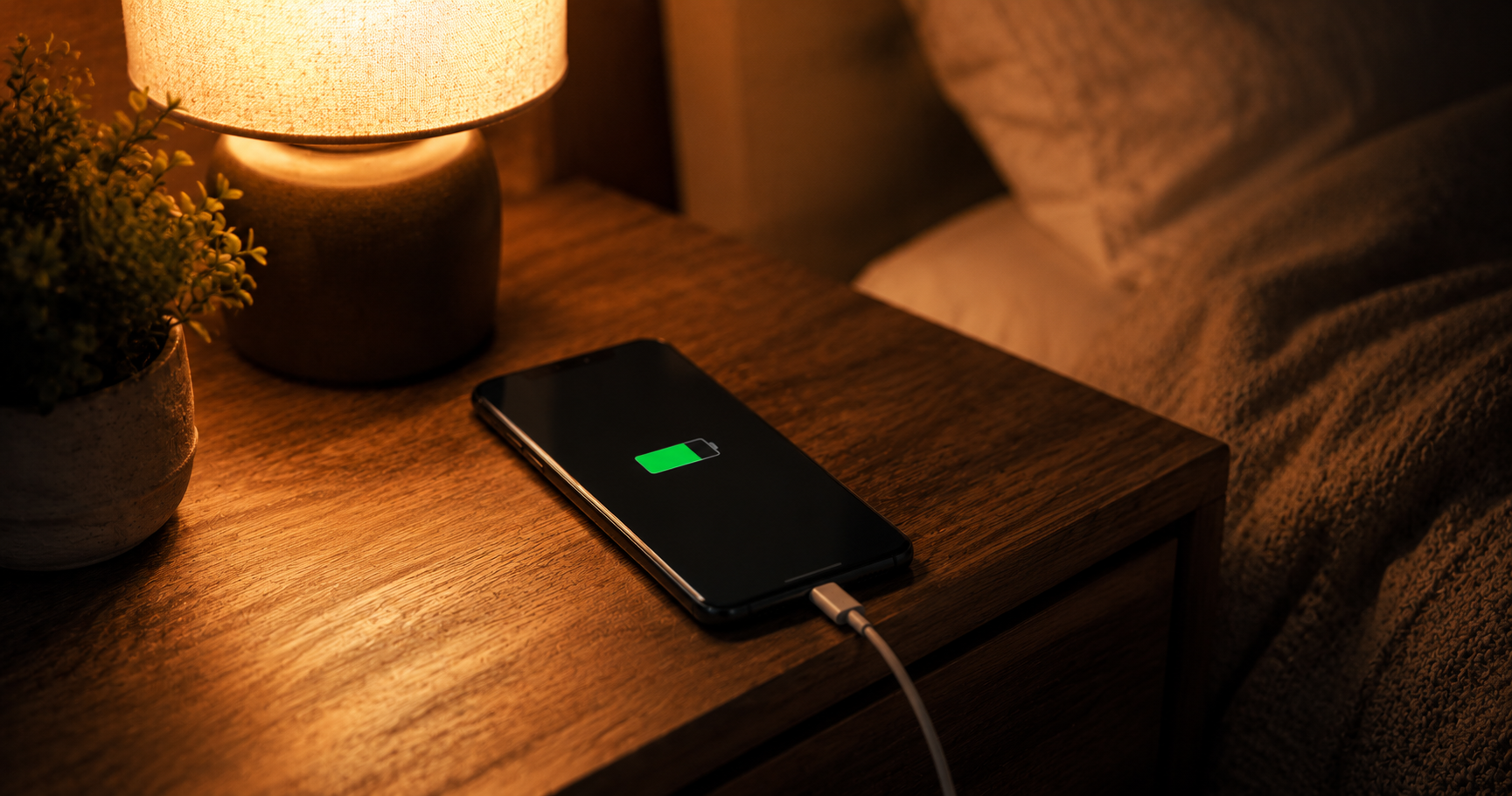
Modern phones have built-in protection that automatically stops the battery from charging past 100 percent, preventing damage from overcharging. Your phone will not catch fire because you left it plugged in while you slept. That fear belongs to an earlier generation of battery technology.
The caveat is trickle charging. Each time the battery drops to 99 percent because apps are running in the background, it starts charging again to maintain a full state. Sitting at 100 percent creates slightly more chemical stress than hovering between 20 and 80 percent, and repeated trickle charging wears the battery down over long periods.
Manufacturers already solved this. Apple’s iPhones can delay charging past 80 percent until shortly before you normally wake up. Samsung Galaxy phones offer protect battery settings that cap charging. These features learn your routine and hold the phone at a lower charge for most of the night.
What to actually do: Turn on optimised or adaptive charging in your settings and stop thinking about it. That is the whole solution.
Myth 2: You Should Let the Battery Die Completely Before Charging
False, and actively harmful.
This is the most persistent myth and the most damaging one. It comes from the nickel-cadmium era, when batteries suffered from a genuine memory effect that required full discharge cycles. Modern lithium-ion batteries have no memory effect and do not require calibration.
Letting a phone reach zero percent causes unnecessary stress. Deep discharge can damage electrode materials and potentially cause permanent capacity loss. Regularly running down to empty and then charging back to full accelerates ageing, which is the exact opposite of what you want.
What to actually do: Plug in when you reach 15 to 20 percent. Do not wait for the phone to shut itself off.
Myth 3: You Must Use the Original Charger or You Will Destroy the Phone
No longer true.
Most mainstream smartphones including iPhones, Pixels, Galaxy devices, and Xiaomi phones support the universal USB Power Delivery standard. You can safely use high-quality PD chargers from reputable third-party brands without any risk to your device.
The genuine exceptions are proprietary fast-charging systems. Oppo and OnePlus SuperVOOC, Qualcomm Quick Charge, and Huawei SuperCharge all require their official power bricks to reach maximum advertised speeds. Using a generic charger with these phones is safe, it will simply charge more slowly.
What does matter is quality. Cheap unbranded chargers from roadside stalls can deliver unstable voltage and generate excess heat, and heat is the thing that genuinely kills batteries. This is a real concern in Pakistan and India where counterfeit chargers are widespread. To read more phone guides and comparisons, visit GmoArena’s Mobile Phones section.
What to actually do: Buy from a reputable brand. Anker, Belkin, Baseus, and UGREEN all make reliable chargers. Avoid anything suspiciously cheap.
Myth 4: Fast Charging Ruins Your Battery
Partially true, and less important than people think.
Fast charging generates more heat than slow charging, and frequent fast charging may slightly increase battery wear over time. That much is real.
But manufacturers design phones to manage this heat, and occasional fast charging is perfectly safe. The convenience of getting from 20 to 80 percent in twenty minutes generally outweighs a marginal reduction in battery lifespan two years down the line.
For Pakistani users specifically, fast charging is often not optional. When electricity availability is unpredictable during loadshedding, being able to charge substantially in a twenty-minute window is worth far more than theoretical battery preservation.
What to actually do: Use fast charging when you need it. Use slower charging overnight or when you are not in a hurry. Remove thick cases while fast charging to help heat escape.
Myth 5: The 20 to 80 Rule Is Essential
True in principle, overstated in practice.
The rule has genuine scientific basis. Keeping a battery between 20 and 80 percent does reduce stress on lithium-ion cells, and 50 percent is where the battery reaches internal equilibrium.
However, modern devices already compensate. Built-in buffers mean the 100 percent your phone displays is not the true chemical maximum of the cell, and smart charging features handle optimisation automatically. Obsessively unplugging at 80 percent and plugging in at 20 percent produces a marginal benefit that most users will never notice.
More importantly, heat matters more than percentages. Temperature is the single biggest factor in battery degradation, and no amount of careful percentage management compensates for repeatedly cooking your phone.
What to actually do: Avoid the extremes when convenient. Do not restructure your day around it.
Myth 6: Heat Is Overrated as a Concern
Completely false. This is the one that actually matters.
Temperatures above 35 degrees Celsius cause permanent, irreversible damage to battery capacity. Not temporary reduction. Permanent loss. Even storing a phone in a hot environment shortens its operational lifespan without the phone being used at all.
For anyone reading this in Pakistan or India, this is the single most relevant fact in this entire article. Summer temperatures routinely exceed 40 degrees Celsius. A phone left on a car dashboard, in direct sunlight, or in a pocket during outdoor work in June is taking damage that no charging habit can undo.
What to actually do: Never leave your phone in a parked car. Keep it out of direct sunlight. Remove the case if the phone feels hot. Do not game or navigate while charging in hot weather. Avoid using it heavily immediately after removing it from a hot environment.
If you follow only one recommendation from this article, follow this one.
Myth 7: Closing Background Apps Saves Battery
False, and mildly counterproductive.
Android and iOS both manage background processes far more efficiently than manually swiping apps closed. When you force close an app you use regularly, the system must fully reload it the next time you open it, which consumes more power than leaving it suspended in memory.
What to actually do: Leave apps alone. If a specific app is genuinely draining power, your phone’s battery settings will identify it by name.
What Genuinely Extends Battery Lifespan
Stripping away everything above, five things actually matter.
Keep the phone cool. Heat is the primary killer. Everything else is secondary.
Enable optimised charging. One setting, permanent benefit, no ongoing effort.
Avoid draining to zero. Plug in around 15 to 20 percent.
Use quality chargers. Not necessarily the original one, but not a counterfeit either.
Accept that batteries age. After two to three years your battery will hold noticeably less charge. That is chemistry, not failure. A replacement battery is usually far cheaper than a new phone and often the more sensible option.
Is it bad to charge your phone overnight in 2026?
No, overnight charging is safe on modern smartphones. Built-in battery management systems automatically stop charging at 100 percent, preventing overcharging. The minor concern is trickle charging, where the battery repeatedly tops itself back up to 100 percent through the night, which creates slightly more chemical stress than sitting at a lower charge. Both Apple and Samsung address this with optimised charging features that delay reaching full charge until shortly before you normally wake. Enabling that setting eliminates the concern entirely.
Should I let my phone battery drain to zero before charging?
No. This advice comes from nickel-cadmium batteries which suffered from memory effect and required full discharge cycles. Modern lithium-ion batteries have no memory effect and do not require calibration. Allowing a phone to reach zero percent causes unnecessary stress, and deep discharge can damage electrode materials and cause permanent capacity loss. Charge your phone when it reaches 15 to 20 percent rather than waiting for it to shut down.
What actually damages phone batteries the most?
Heat is the single biggest factor in battery degradation. Temperatures above 35 degrees Celsius cause permanent, irreversible damage to battery capacity, and even storing a phone in a hot environment without using it shortens its lifespan. This makes heat management the most important consideration for users in hot climates including Pakistan and India, where summer temperatures regularly exceed 40 degrees Celsius. Never leave a phone in a parked car or direct sunlight, and remove the case if the device feels hot during charging or heavy use.
The Short Version
Charge overnight if you want, but turn on optimised charging. Do not let the battery hit zero. Use a decent charger regardless of brand. Stop closing background apps. And above all, keep the phone out of the heat, because in this part of the world that is what is actually shortening your battery life, not whatever your uncle told you about charging cycles.
Your battery will still degrade. All of them do. But you will get a meaningfully longer useful life out of it, and you will stop worrying about a set of rules that stopped applying two decades ago.
For more practical phone guides, comparisons, and buying advice, visit GmoArena’s Mobile Phones section.
Sources and Further Reading
- The Conversation on overnight charging, trickle charging and battery cycle research
- PES Supply analysis of whether the 20 to 80 percent rule still applies in 2026
- Topicsolutions breakdown of eight common phone battery myths and charger compatibility
About this article: Written by the GmoArena editorial team covering global celebrity culture, mobile technology, travel destinations, and the stories that matter.
Editorial Note: Battery guidance in this article is based on published research and reporting from The Conversation, PES Supply, BGR, and Topicsolutions during 2026. Battery behaviour varies between manufacturers and models. Consult your device manufacturer’s official documentation for guidance specific to your phone.